What You See on an Oslofjord Cruise
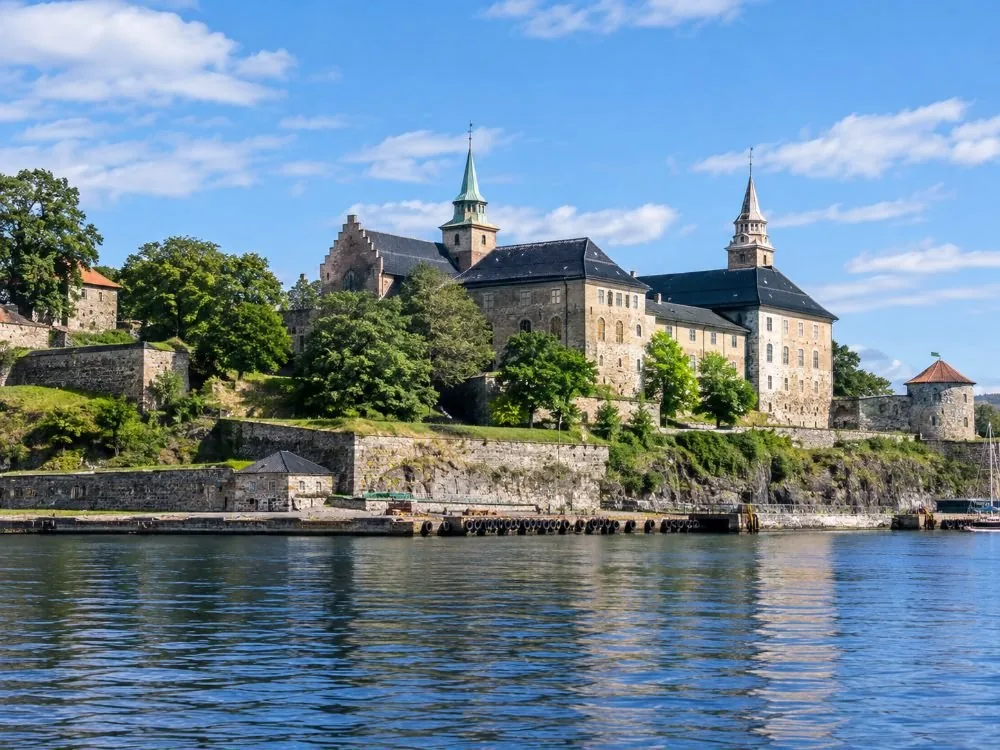
Akershus Fortress
The first thing you pass and the only one you will photograph badly, because you are close and it is above you. It sits on the headland that divides the inner harbour, which is exactly why it is there. From the water you get the thing you cannot get from the street: the fortress reading as a defensive position over a sea approach rather than as a park with old walls in it.
The Opera House and Bjørvika
White, low, sloping into the water on the eastern side. From a boat you see what the building is actually doing — meeting the fjord at the waterline instead of standing back from it. Boats from Langkaia start here and work west; boats from the Rådhusbrygge quays see it across the harbour a few minutes in. Which boat leaves from where.
Aker brygge and Tjuvholmen
The rebuilt waterfront, glass and timber decking, and the part of the trip where the commentary usually says the word “shipyard”. It is the clearest demonstration on the route of what this city did with its harbour when the industry left it.
Bygdøy
Wooded, low, almost rural from the water, and full of museums you are not going to. No city cruise lands there and no ticket here includes museum entry, though the wooden ship’s booking does come with a Bygdøy ferry ticket for a separate trip — that boat has no guaranteed seat on the cruise itself, since boarding is open. Bygdøy from the water.
Dyna lighthouse
A small lighthouse on a skerry in the middle of the harbour, and the moment on most routes when the city stops being the subject and the water starts. Everybody on the open deck takes the same photograph and it is a good photograph.
The islands
Hovedøya first, then Lindøya, Nakholmen, Gressholmen and Bleikøya, low and green with small painted cabins along the shorelines. This is the part of the trip people remember, and it is also the part you can do on a Ruter ticket if you would rather land than look — the B1 leaves from Rådhusbrygge 4, the same quay as two of these cruises. The islands, one by one.
The traffic
Do not skip this bit. You will pass the Kiel ship at Filipstad or Hjortnes and the Copenhagen ship at Vippetangen, and across on the eastern shore is the container terminal at Sjursøya with its cranes working. A fjord with a port in it is a more honest thing to look at than a fjord pretending there is no port. Where to stand for all of this.
The version with somebody naming it as you pass
Two hours from Rådhusbrygge 2 on a hybrid-electric boat, three open decks and two heated saloons, and the only live-guided city cruise in this catalogue — in English only, 4.7 from about 2,079 reviews.
Frequently asked questions
What do you see on an Oslofjord cruise?
Akershus Fortress, the Opera House across Bjørvika, Aker brygge and Tjuvholmen, the wooded Bygdøy peninsula, Dyna lighthouse on its skerry, and the near islands — Hovedøya, Lindøya, Nakholmen, Gressholmen and Bleikøya — plus the ferries to Kiel and Copenhagen and the container port at Sjursøya. Which quay you sail from changes the order.
Do Oslofjord cruises go to Oscarsborg or Drøbak?
No. Both are far south of the city, past the narrows, and no city cruise reaches them. Ruter’s B21 and B22 boats go to Drøbak — weekends in spring and autumn, daily in summer. Oscarsborg, and how to get there.
Do you get off the boat anywhere?
On five of the six, no — you return to the quay you left from. The six-hour trip lands on five islands and walks them with a live guide in English, 4.5 from about 158 reviews; it is not wheelchair accessible, involves walking and climbing, and under-15s need an adult with them. Island hopping.