Is the Oslofjord a Real Fjord?
What a sill fjord is
A fjord is a drowned trough with a threshold at its mouth. The threshold is the definition, not the cliff walls. Water outside moves freely; water inside sits behind the lip and exchanges slowly and only when the conditions outside are right to push heavier water over it. The Oslofjord has that architecture in an unusually clean form: a narrow, shallow constriction at Drøbak, roughly 17 km of narrows about a kilometre wide, and deep enclosed basins above it. By the definition working oceanographers actually use, this is a textbook case rather than a marginal one.
Where the internet goes wrong
Search this question and you will find confident posts saying the Oslofjord is not a fjord at all. That is not a nuance, it is an error, and it comes from conflating two different claims. The true claim is that the Oslofjord was not gouged out by a glacier the way the western fjords were. The false claim is that it therefore is not one. A fault-controlled trough that ice later deepened and drowned, with a sill at its mouth, is a fjord. The people who write the reference works file it as one.
The rift underneath
The Oslo Rift is a graben — a block of crust that dropped between faults — and it is old, Permian. That is hundreds of millions of years before any ice sheet came near it. So the shape of the fjord was set by tectonics first and edited by glaciers afterwards, which is why its profile is broad and its shores are wooded slopes rather than walls. If you want the vertical rock, you want the other side of the country. That comparison is here.
The sill is not an abstraction. It is the reason the deep water in the inner basins goes stale and, in several of them, loses its oxygen entirely. Geology explains the wildlife page better than the wildlife page explains itself — the state of the fjord.
So what are you actually looking at from the boat
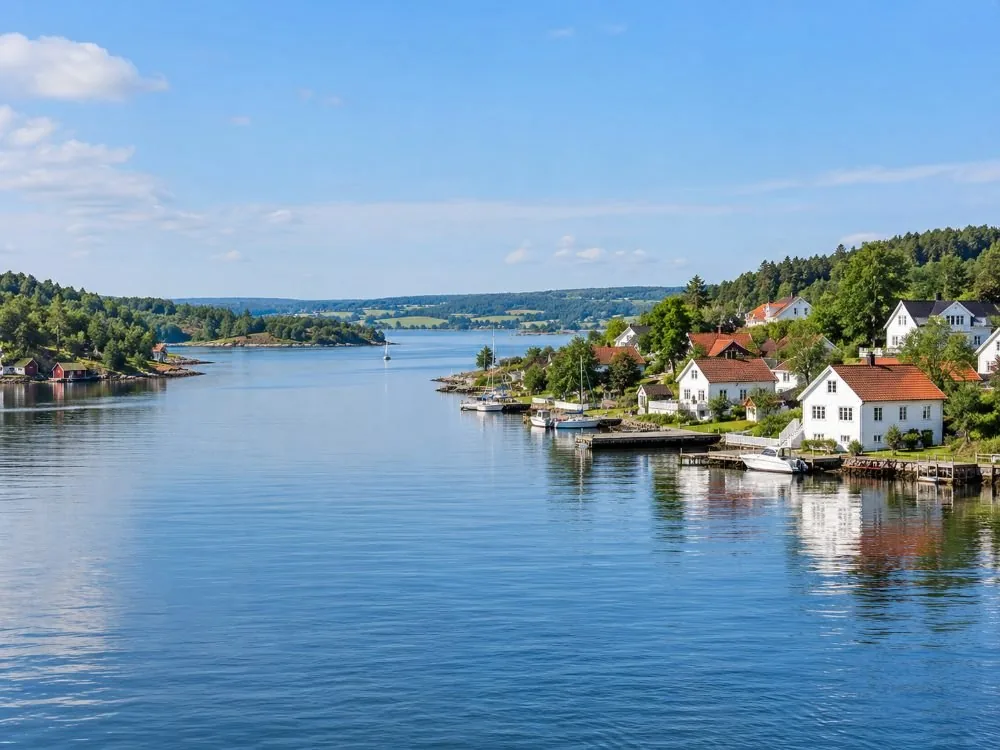
A drowned rift valley with a working capital on its shoulder. Akershus on the headland, the Opera House across the water in Bjørvika, low wooded islands with summer cabins on them, and ships leaving for Kiel and Copenhagen while you go past. That is a genuinely good ninety minutes, and it is more interesting once you know the ground under it is a fault line rather than a glacier scratch. Landmark by landmark.
The cruise where you can ask about this
The only live-guided city cruise in this catalogue, in English only, from Rådhusbrygge 2 — two hours, hybrid-electric, 4.7 from about 2,079 reviews. Everything else here runs on recorded audio, which does not answer questions.
Frequently asked questions
Is the Oslofjord a real fjord or just a bay?
A real fjord. It is classified as a sill fjord — a terskelfjord — because of the shallow threshold at Drøbak, about 19 m deep, with basins to about 160 m behind it. Store norske leksikon files it that way and Britannica describes it as a partially filled, partially reexcavated graben. The fjord in numbers.
Why do people say the Oslofjord is not a fjord?
Because it was not carved by a glacier the way Geirangerfjord was. It sits in the Oslo Rift, a Permian fault depression that ice later reworked. That makes it a different kind of fjord, not a non-fjord. What it is not.
Does it look like a fjord from a sightseeing boat?
It looks like a broad, wooded, island-scattered inlet with a capital city on it — not like a gorge. If you board expecting walls of rock you will be disappointed at about the four-minute mark. What is actually out there.